
Lead
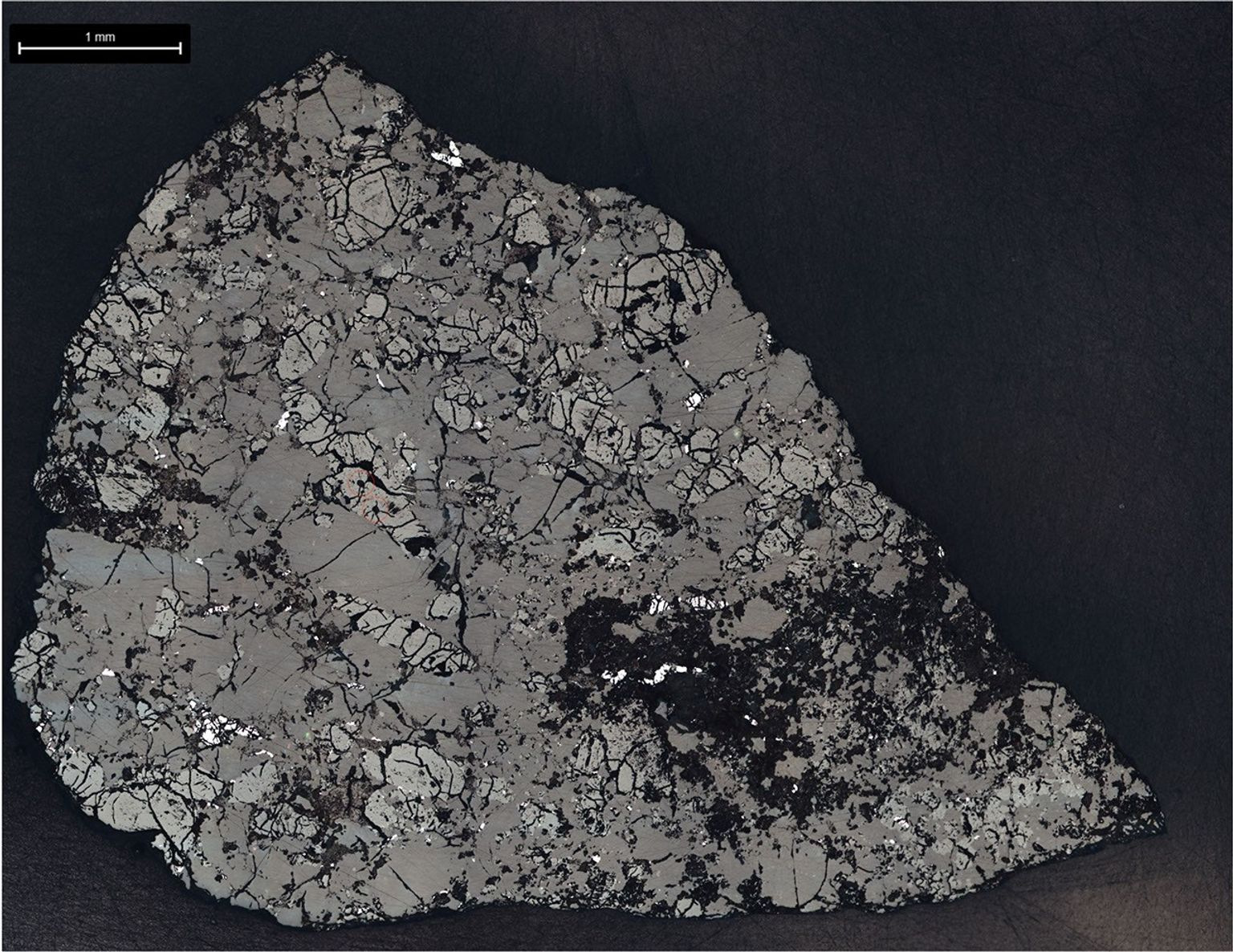
Scientists at NASA have unveiled a high-resolution slice of the Teghaza 001 meteorite, one of the most ancient Martian rocks ever discovered on Earth. The sample, which originated from Mars, has been instrumental in determining the age of the rock and offers a rare glimpse into the planet’s early geological formation. The image, captured through reflected light, serves as a visual guide for researchers to locate and analyze specific minerals of scientific interest.
Background: What Is Teghaza 001?
Teghaza 001 is a Martian meteorite that was discovered in the Sahara Desert in 2008. It was identified through spectral analysis and confirmed as extraterrestrial through isotopic dating. The meteorite is classified as a shergottite, a type of igneous rock formed from volcanic activity on Mars. These rocks are typically found in the southern highlands of Mars and are believed to have formed over 4 billion years ago.
Among all known Martian meteorites, Teghaza 001 is considered one of the oldest, with an estimated age of approximately 4.5 billion years. This makes it a critical specimen for understanding the early history of Mars, particularly the formation of its crust and the conditions that existed during the planet’s first billion years.
Scientific Significance of the Slice
The slice of Teghaza 001 presented in the NASA photojournal is not a physical sample in the traditional sense, but a high-resolution image captured using reflected light. This technique allows scientists to visualize the internal structure of the meteorite without destructive sampling.
By analyzing the texture, color, and mineral distribution in the image, researchers can identify areas rich in minerals such as olivine, pyroxene, and plagioclase—common components in Martian volcanic rocks. These minerals are key indicators of past volcanic activity and tectonic processes on Mars.
Reflected light imaging is a non-invasive method that enables scientists to map mineralogical features across the surface of the meteorite. This visual roadmap helps guide the selection of regions for further analysis using instruments such as electron microscopes or X-ray diffraction systems, which require precise targeting.
How the Age Was Determined
The age of Teghaza 001 was established through isotopic analysis of its mineral composition. Specifically, scientists measured the ratios of isotopes of elements such as iron and oxygen, which are known to change over time due to radioactive decay.
These isotopic measurements were conducted at the NASA Johnson Space Center’s planetary science laboratory. The data collected from the sample indicated that the rock formed around 4.5 billion years ago, coinciding with the early stages of Mars’ formation. This timing aligns with the period when Mars was undergoing intense volcanic activity and had a molten surface.
Because Teghaza 001 is among the oldest Martian meteorites ever found, its age provides a benchmark for understanding the timeline of Martian geological evolution. It helps establish a timeline for when Mars began to cool, when its crust solidified, and when volcanic activity declined.
Contextualizing Mars’ Early History
Mars is believed to have formed about 4.6 billion years ago, shortly after the formation of the solar system. Early Mars was likely warmer and more geologically active than it is today, with a thicker atmosphere and liquid water on its surface.
By studying ancient meteorites like Teghaza 001, scientists can infer conditions on early Mars without relying on data from orbiters or landers, which may only provide limited surface coverage. Martian meteorites offer a direct sample of the planet’s crust, preserving information that may have been erased by erosion or atmospheric changes over billions of years.
These meteorites are thought to have been ejected from Mars’ surface by large impact events, then traveled through space for millions of years before eventually landing on Earth. The Teghaza 001 meteorite is believed to have been launched from Mars around 1.5 million years ago, after which it traveled through the solar system and was eventually captured by Earth’s gravity.
Limitations and Challenges in Analysis
While the reflected light image provides valuable context, it does not offer direct chemical or isotopic data. The actual age and mineral composition of Teghaza 001 were determined through laboratory-based isotopic analysis, not from the image itself.
Moreover, the meteorite’s surface has been exposed to Earth’s atmosphere and environment since its arrival. This exposure may have led to minor surface alteration, such as oxidation or contamination, which could affect the accuracy of certain measurements. Scientists have accounted for these effects by comparing the sample’s data with known Martian rock types and using calibration methods.
Additionally, the meteorite is not unique in its age or composition. Other Martian meteorites, such as ALH 84001 and EETA 79001, have also been studied for their geological and chemical properties. However, Teghaza 001 stands out due to its age and the precision with which its formation timeline has been established.
Implications for Future Mars Missions
The study of Teghaza 001 contributes to the broader scientific effort to understand Mars’ early environment. This knowledge is essential for planning future missions, such as those aimed at searching for signs of past or present life on Mars.
For instance, understanding the types of volcanic rocks and their ages helps scientists identify regions on Mars that may have once hosted liquid water or had favorable conditions for microbial life. The presence of ancient volcanic activity suggests that Mars may have had a dynamic geologic history, which could have supported habitable environments.
Moreover, the techniques used to analyze Teghaza 001—such as reflected light imaging and isotopic dating—can be applied to future samples collected by Mars rovers or landers. As NASA and other space agencies prepare for sample return missions, the methods developed from studying meteorites like Teghaza 001 will play a vital role in guiding in-situ analysis.
Current Status and Future Research
As of the latest update, the Teghaza 001 meteorite remains in the collection of the NASA Johnson Space Center. It is not currently being used in active experiments, but it is part of an archive of Martian meteorites that are periodically re-examined for new scientific insights.
Future research may focus on comparing Teghaza 001 with other Martian meteorites to identify patterns in mineral composition and age distribution. This comparative analysis could reveal whether certain regions of Mars were geologically more active than others, or whether volcanic activity was widespread or localized.
Additionally, advancements in imaging technology may allow for even more detailed analysis of meteorite slices in the future. For example, synchrotron X-ray imaging or laser-induced breakdown spectroscopy could provide higher-resolution data on mineral distribution and chemical composition without damaging the sample.
While the current image of Teghaza 001 is a static visual, it represents a critical step in the scientific process of interpreting extraterrestrial materials. It serves as a bridge between the observation of a rock on Earth and the interpretation of Mars’ early history.
Scientists emphasize that meteorites like Teghaza 001 are not just geological curiosities—they are vital tools for reconstructing the history of planetary formation and evolution. Each meteorite adds a piece to the puzzle of how planets like Mars came to be, and how they changed over time.