
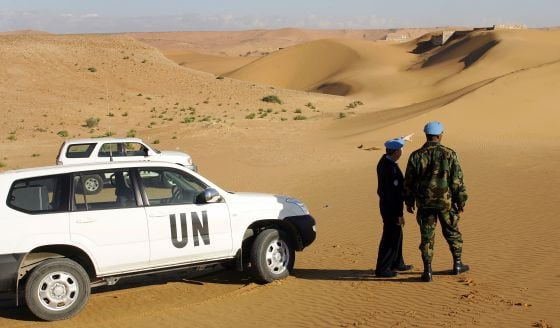
UN Orders Disbanding Mission in Sahara as Risk of Military Escalation Rises
The United Nations Mission in Western Sahara (MINURSO) will be officially disbanded following a cross-veto by the United States and Russia, according to today's report by El País. The decision, made by the UN Security Council, marks the end of a 35-year operation that has failed to achieve its fundamental objective: organizing a self-determination referendum for the inhabitants of Western Sahara.
Historical Context of MINURSO
MINURSO was established in 1984 in response to the growing political and military tensions that intensified after the declaration of independence of Western Sahara by liberation movements, such as the Polisario Front. Since then, the mission has had as its primary objective ensuring a ceasefire between Moroccan forces and liberation movements, and facilitating a process of self-determination for the inhabitants of the territory.
The original mandate, established in UN Security Council Resolution 47/114, included supervising a referendum that would allow the inhabitants of Western Sahara to choose between integration with Morocco or independence. Although several proposals and agreements have been made, no official referendum has ever been held, and the implementation of the mandate has been repeatedly interrupted by political and diplomatic obstacles.
Failure to Fulfill the Mandate
Since 2020, MINURSO has faced a growing crisis in its ability to ensure a ceasefire. Although several incidents of confrontation between Moroccan forces and liberation groups, such as the Polisario, have been recorded, the mission has failed to intervene effectively to prevent serious conflicts. On multiple occasions, Moroccan forces have restricted access to areas of the Sahara, especially in the most vulnerable regions, such as the northern part of the territory.
Moreover, the UN has acknowledged that MINURSO has failed to fulfill its obligation to organize a self-determination referendum. Despite several plans and proposals being presented, such as the 2022 plan which included a dialogue agenda between Morocco and the Polisario, these have not been implemented. The absence of a formal democratic process has generated growing distrust among local communities and international organizations.
The Cross-Veto by the United States and Russia
The closure of the Minurso took place after a cross-veto by the United States and Russia in the United Nations Security Council. Both powers have expressed their opposition to the continuation of the mission, arguing that it fails to meet its original objectives and that its presence generates instability in the territory.<\/p>
The United States, which has maintained a critical stance toward the strengthening of liberation movements in the Sahara, has argued that Minurso has been used as a tool to promote the independence of the Sahara, which could affect diplomatic relations with Morocco. On the other hand, Russia has stated that the mission has not achieved significant progress toward peace and that its presence has been ineffective in preventing conflicts.<\/p>
The veto was presented during a Security Council session in November 2026, where the possibility of restructuring or dismantling the mission was discussed. Although other UN members, such as France and the United Kingdom, have expressed support for the continuation of Minurso, the cross-veto was sufficient for the Council to decide to withdraw the official mandate.<\/p>
Implications for Western Sahara
The deactivation of Minurso has profound implications for Western Sahara. Without an international institution overseeing the ceasefire and promoting dialogue, the risk of a military escalation increases significantly. Local communities, especially in rural and border areas, could face greater exposure to armed conflicts, as the presence of the mission has been a stabilizing factor.<\/p>
Moreover, the absence of a self-determination referendum leaves open the question of the territory's political future. Although Western Sahara has been recognized as part of Morocco by many countries, other continents and international organizations consider it a disputed territory with the right to decide its own fate.<\/p>
International Reactions
The decision has generated mixed reactions on the international stage. Countries such as Spain, which has maintained a stance in support of the right to self-determination of the Sahara, have expressed concern over the closure of the mission. In an official statement, Spain's Ministry of Foreign Affairs emphasized that Minurso was a key instrument for ensuring peace and development in the territory.<\/p>
On the other hand, Morocco has welcomed the decision, stating that the withdrawal of the mission is a step toward stability and the integration of the Sahara as part of its national territory. The Moroccan government has emphasized that peace in the region is achieved through the strengthening of national institutions and regional cooperation, without the need for international interventions.<\/p>
The Polisario, on the other hand, has denounced the decision as a violation of international law and has warned that the Sahara will remain a disputed territory without a democratic solution.<\/p>
Implications for international politics
The case of UNMIS represents an example of how decisions by the UN Security Council can be influenced by the geopolitical interests of key powers. The cross-veto between the United States and Russia not only affects the Sahara, but also highlights the weakness of the international peace system in managing prolonged conflicts.<\/p>
This case also reflects a growing trend within the UN: the reduction in the number of peacekeeping missions, especially in regions where conflicts have lost their character of