
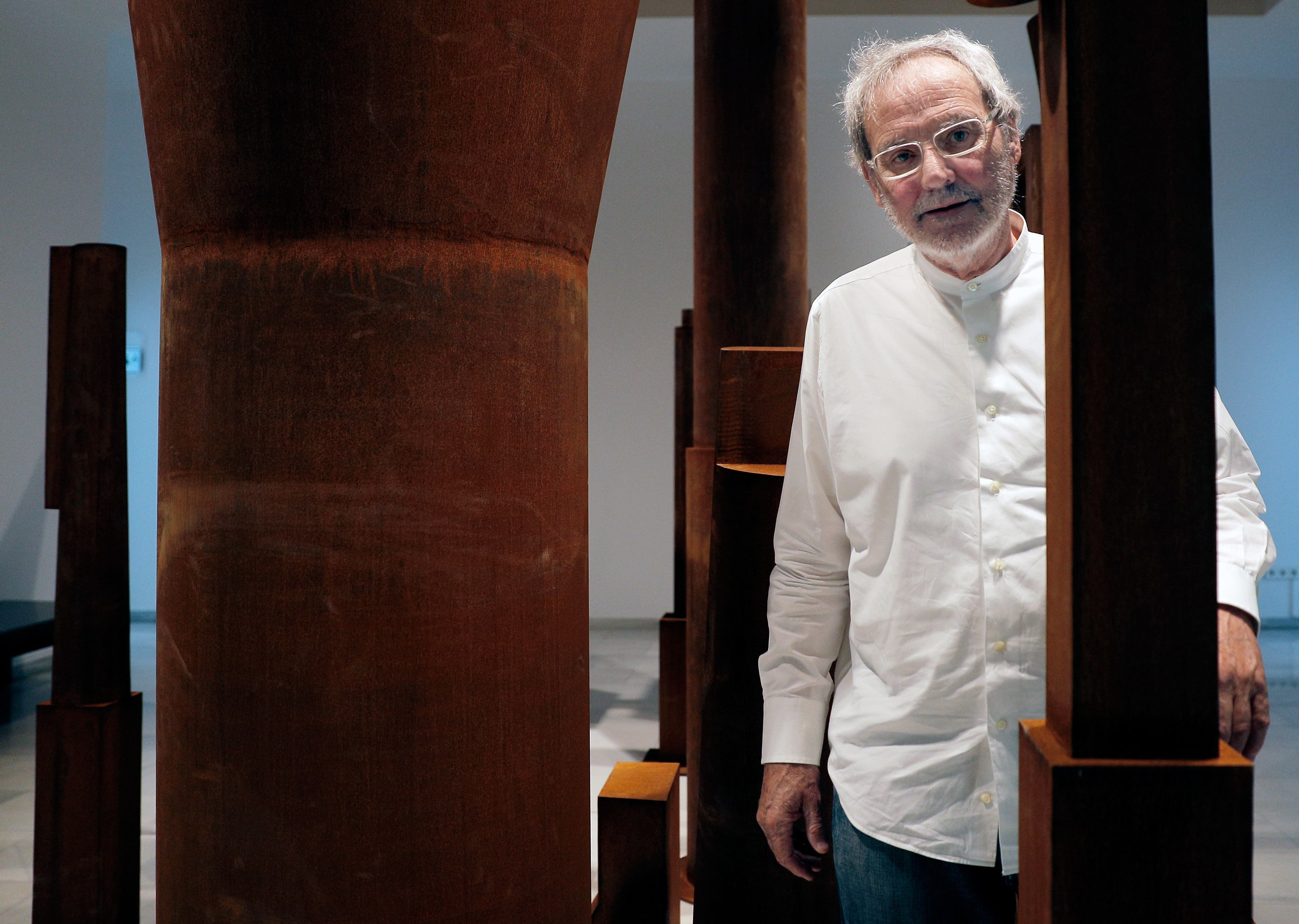
Madrid, November 1, 2026 — Miquel Navarro, a renowned Valencian sculptor and pioneer of Spanish New Sculpture, died at the age of 81. The news was confirmed by sources close to Valencian art and by specialized media, although no official cause of death has been recorded. Navarro, whose work is characterized by the integration of urban elements and the creation of totemic cities, left a deep mark on the Spanish art scene.<\/p>
The artist was born in 1944 in the municipality of Mislata, in the province of València. From an early age, he showed a particular interest in sculpture, especially in the use of natural materials and the representation of urban structures. His artistic trajectory solidified in the 1970s and 1980s, when he began exploring new forms of sculptural expression that challenged traditional conventions in art.<\/p>
The National Prize and artistic recognition
In 1986, Miquel Navarro received the National Prize in the Arts, an award recognizing Spanish artists who have made significant contributions to the development of national art. Granted by the Ministry of Culture, this honor validated his work, particularly for his innovation in the use of materials such as wood, stone, and metal, and for his ability to transform urban spaces into living sculptures.<\/p>
Navarro's work did not stop at the creation of individual pieces. His approach focused on the construction of artistic environments, where each sculpture was part of a set that interacted with the urban surroundings. This approach led to his recognition as one of the main figures of Spanish New Sculpture, a movement that emerged in the 1970s and sought to break away from academic art and explore new forms of expression.<\/p>
Totemic cities: an urban vision
One of the most distinctive features of Navarro's work was his creation of 'totemic cities'. These are not cities in the geographical sense, but urban environments designed as collections of sculptures that represent symbolic elements of a community. Each sculpture functions as a 'totem', a symbol that embodies a cultural identity, a history, or a collective value.<\/p>
In his projects, Navarro integrated local environmental elements: natural stones, wooden structures, earth textures. Sculpture was not merely a visual object, but a sensory experience that invited the public to interact with the space. For example, in the municipality of Mislata, he created a series of sculptures reflecting the community's history, such as the transition of rural workers to urban modernity.<\/p>
These totemic cities were not permanent constructions, but rather developed in phases, with new elements added as the community grew. Thus, Navarro's art became a process of dialogue between the artist, the space, and the inhabitants of the place.
The Workshop House in Mislata: the last dream fulfilled
One of Miquel Navarro's last wishes was to open a Workshop House in his native town, Mislata. This space, which became his final project, was inaugurated in 2025, shortly before his death. The Workshop House is not merely an exhibition space, but an open workspace where young artists can learn sculpting techniques and experiment with natural materials.
The project was promoted by the Mislata City Council and supported by local cultural institutions. The structure, built with sustainable materials, is located in a municipal park and includes an exhibition room, a carving area, and a space for artistic events. The idea was that the Workshop House would serve as a meeting point between art and the community, allowing residents to participate in creating sculptures that reflect their identity.
In a 2024 interview, Navarro stated that his goal was «to create spaces where art is not confined to a gallery, but is part of people's daily lives». This philosophy is directly reflected in the Workshop House, which not only exhibits works but also enables active public participation in the creative process.
Historical and artistic context
Spanish New Sculpture, in which Navarro played a key role, emerged as a response to the need to transform art into a more accessible and environment-linked language. In contrast to traditional art, which often appeared in closed and distant spaces, this movement sought to place art in urban spaces, on streets, in parks, and in neighborhoods.
In the 1970s and 1980s, Spain experienced a deep social and cultural transformation. Art began to detach from academic circles and integrate into everyday life. Navarro, along with other artists such as José María de la Cruz and Rafael Moneo, was part of this shift, promoting art as a form of social and community expression.
Navarro's approach to totemic cities can be seen as an evolution of this trend. While other sculptors of the time focused on individual pieces, Navarro developed a system in which each sculpture was part of a whole, and each whole represented a community. This approach was not only artistic but also sociocultural.
Impact on Spanish contemporary art
The legacy of Miquel Navarro extends beyond his physical works. His approach has influenced generations of artists who seek to integrate art with the urban environment. Many of the contemporary projects in Spain involving sculptures in public spaces, such as installations in parks or plazas, follow a similar line of thinking as Navarro's.
Moreover, his work has been the subject of academic studies in Spanish universities, especially in the fields of art history and urban architecture. In 2023, an exhibition titled «Totémicas: the art of Miquel Navarro» was held at the Museum of Contemporary Art in Valencia, where more than 50 pieces were displayed, including original sculptures and documentation on his creative process.
Experts in contemporary art have highlighted that Navarro was one of the first artists to use the concept of «totemic city» as a model for urban design. Although the term originates from indigenous cultures, Navarro adapted it to the Spanish context, creating a visual language that connected the past with the present.
Legacy and future perspectives
The death of Miquel Nav-than marks the end of an important phase in Spanish art. His work, especially his focus on urban sculpture and community participation, remains a reference point for artists seeking to connect art with everyday life.
The Casa Taller in Mislata, although a physical space, represents a continuity of his thinking. By allowing young artists and citizens to participate in the creation process, the space becomes a living laboratory of his artistic philosophy. This model could serve as inspiration for other municipalities that wish to integrate art into their public spaces.
In an environment where art is increasingly seen as a tool for social transformation, Navarro's legacy is especially relevant. His work was not only an aesthetic expression but also a form of community building, a dialogue between the artist and the people.
Experts in art and urban culture indicate that in the coming years, there will likely be more projects similar to Navarro's, especially in rural areas or communities that seek to strengthen their cultural identity through art.
The passing of Miquel Navarro is not only a personal loss for the art world, but also a signal that Spanish contemporary art is entering a phase of consolidation of models that prioritize community, environment, and participation.