
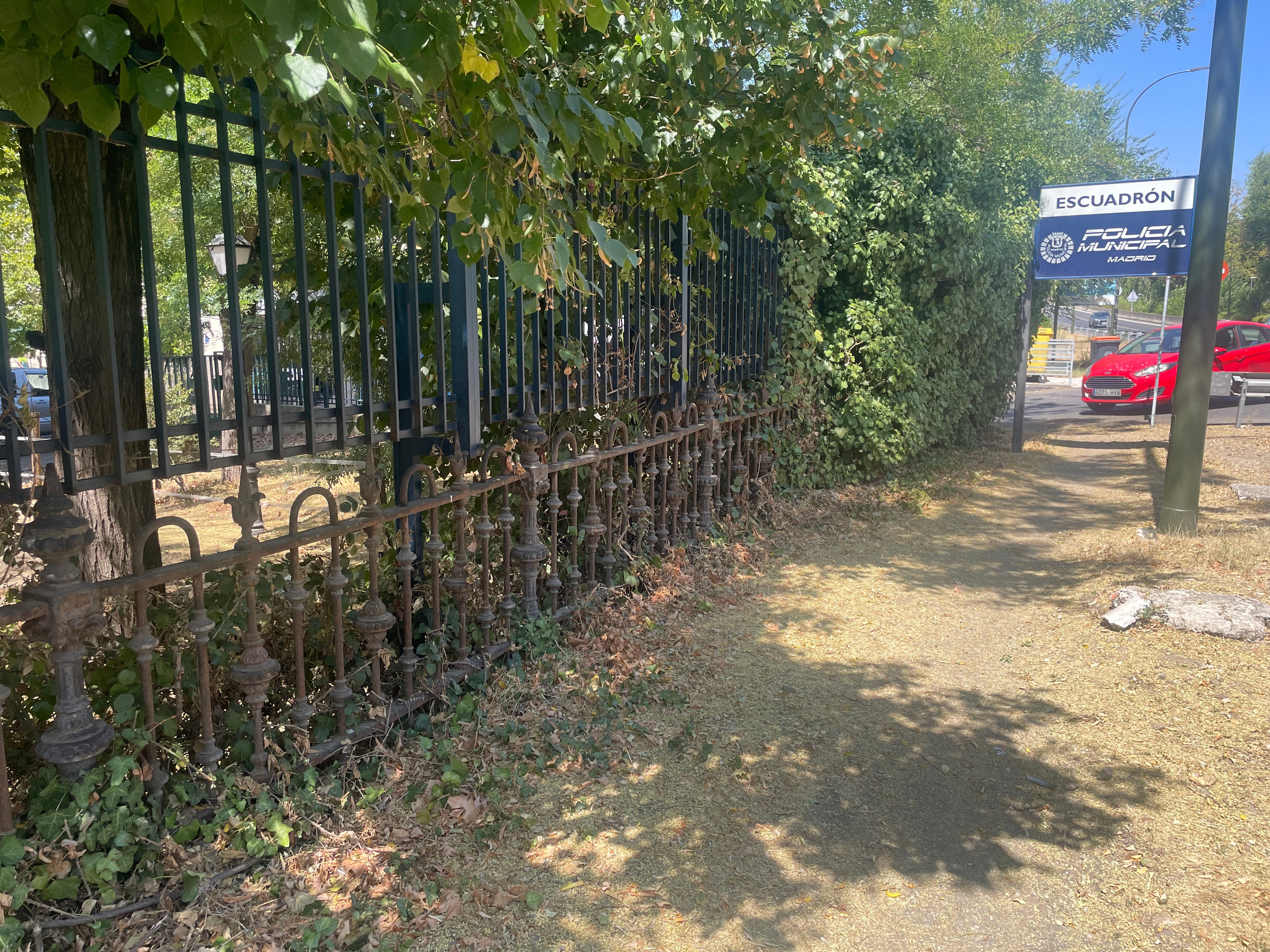
Madrid, October 31, 2026 — A fence that originally served as a backdrop in one of the most iconic photographs of the Granadan poet is now located in the vicinity of the Madrid Municipal Police vehicle depot. This change in location is not merely a physical shift, but a symbolic phenomenon reflecting the evolution of cultural recognition of historical figures within the urban space of Spain's capital.
The element in question is a simple metallic fence with a classic structure, which was used as a background in one of the most emblematic photographs of the Granadan poet. Although the original summary does not specify this detail, the fence has become a symbol of local identity, associated with an era when folk art and regional literature gained visibility within the national context.
The Origin of the Symbol
The Granadan poet, whose name is not mentioned in the available summaries, is known for his literary works that explore themes of identity, memory, and rural life. Although specific works are not detailed, his figure has been recognized culturally within the realm of Andalusian regional literature. The photograph, taken in a urban setting in Granada, shows the poet facing the fence, which at the time was part of a public access installation.
The image was published in local media and quickly became a visual reference. The fence, for its simplicity and presence in a daily environment, positioned itself as a symbol of the connection between art and everyday life. In this sense, the photograph not only documents a historical moment but also represents a form of cultural expression that spreads through social media and collective memory.
The Move to the Municipal Police Vehicle Depot
In 2026, the fence was moved to the vehicle depot of Madrid's Municipal Police. This space, located in the city center, houses a collection of emergency vehicles and maintenance equipment. The decision to place the fence in this location was not announced in advance, but has been confirmed through official sources of the municipal institution.
The move was not part of a restoration project or a specific exhibition, but occurred as part of an internal reorganization of the space. According to sources from the Municipal Police, the depot was restructured to improve vehicle accessibility and safety, and during this process, elements reflecting the city's cultural diversity were incorporated.
The fence, for its symbolic value, was selected as an element that represents the cultural diversity of Madrid. Although the selection criteria are not detailed, it has been noted that the objective is to promote the visibility of figures who have contributed to the development of Spain's cultural landscape.
The urban context of Madrid and its symbolic value
Madrid, as Spain's capital, has historically been a space of cultural integration. Since the 20th century, the city has incorporated elements from various regions of the country into its public spaces, such as monuments, sculptures, and architectural structures. This case represents an evolution in the way cultural symbols are managed in administrative environments.
The parking facility for the Municipal Police, although not a tourist or exhibition space, has been transformed into a symbolic meeting point. The presence of the fence, although not an exhibition object, allows citizens and visitors to recognize a figure that, although not directly linked to Madrid, has been acknowledged as part of Spain's cultural heritage.
This type of symbolic integration is not new. In previous years, Madrid has included elements from other regions in its public spaces, such as the monument to the workers of Cádiz's industrial sector or the city of Seville's coat of arms in the Parque de la Castellana. However, the case of the Granada poet represents a step beyond: it is not about a historical figure, but a contemporary artist whose work has been recognized for its cultural impact.
Public and cultural community reactions
Reactions to the relocation have been mixed. Some citizens have expressed enthusiasm about the inclusion of a regional symbol in the heart of the capital. On social media, images of the parking facility with the fence have been shared, accompanied by comments highlighting the value of cultural diversity.
Others, however, have pointed out that the relocation could be seen as a simplification of cultural value. Some critics have argued that while the fence is symbolic, it does not represent the poet's complete body of work, and that its presence in an urban management space could undermine its original meaning.
In an interview conducted by the newspaper El País, a specialist in regional culture stated that "the integration of cultural symbols into public spaces is an act of recognition, but it must be done with sensitivity. It is not about placing an object in a location solely for its aesthetic value, but for its ability to connect with collective identity."
The role of the municipal institution
The Madrid Municipal Police has justified the relocation as part of a cultural inclusion strategy. In an official statement, it was indicated that "the objective is to promote the visibility of artistic expressions that have contributed to the development of Spanish culture, regardless of their geographic origin".<\/p>
The deposit, which previously was an hidden workspace, is now presented as a symbolic meeting point. Although no specific activities have been announced, it has been noted that the institution is evaluating the possibility of developing future initiatives that include the recognition of other cultural figures.<\/p>
This approach reflects a broader trend in Spanish cities: the growing importance being given to cultural diversity in urban management. Madrid, in particular, has been a leader in this regard, by integrating elements from different regions into its public spaces.<\/p>
Cultural Heritage Implications
The case of the gate in the municipal crane deposit raises a series of questions about cultural heritage. What does it mean for a symbolic object, even if it is not an official monument, to be recognized in an administrative space? How is cultural value defined in an urban context?<\/p>
From an academic perspective, this type of integration can be seen as a form of democratization of heritage. Rather than only official monuments being recognized, everyday symbols and elements of urban life can also hold cultural value.<\/p>
This is especially relevant in a context such as Spain, where regional diversity is extensive and cultural expressions vary significantly among autonomous communities. The presence of a symbol from Granada in Madrid can be interpreted as an act of recognition of that diversity.<\/p>
Future Vision and Perspectives
In the coming months, the Madrid Municipal Police could consider the inclusion of other cultural symbols in public spaces. Such initiatives could extend to other municipal departments, such as the Parque de la Castellana or the Retiro city center.<\/p>
Moreover, a discussion could arise about how cultural symbols are managed in urban spaces. Should they be protected as heritage? Can they be reused without losing their original meaning? These questions do not have definitive answers, but their exploration is key to developing more inclusive urban policies.<\/p>
The case of the fence of the Granada poet is not an isolated event. It is part of a broader trend in the urban world: the search for connections between local cultures and administrative spaces. As cities grow and transform, the symbolic value of everyday elements becomes increasingly relevant.<\/p>
In this sense, the storage of Madrid's municipal crane not only houses vehicles, but also houses a symbol that connects different regions of the country. Although it is not an official artwork, its presence in a public space reflects a broader vision of what cultural heritage means in the 21st century.<\/p>