
Lead
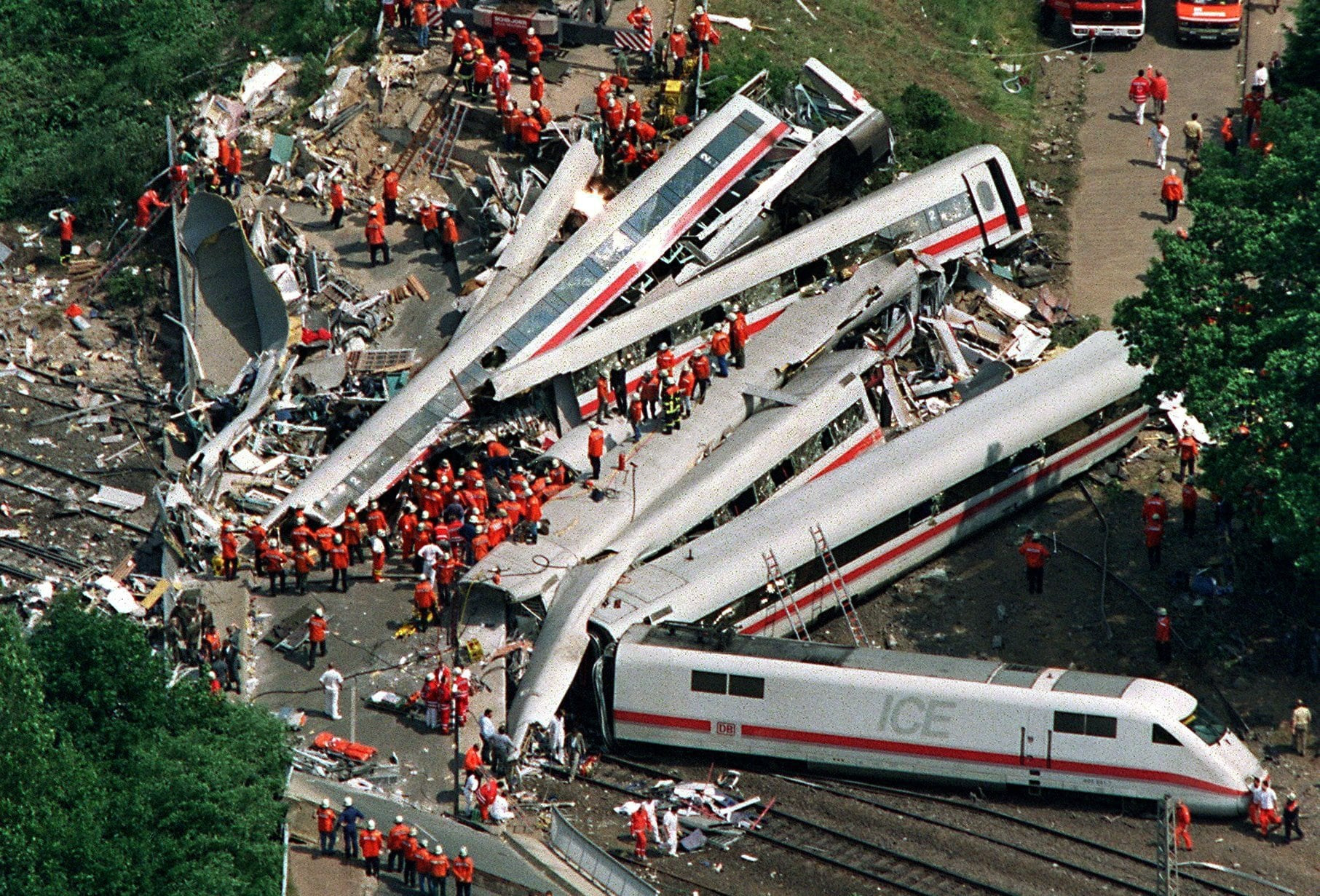
The 1998 high-speed rail derailment in Germany, which left 101 dead, remains the worst incident in the history of Germany's high-speed trains. This event not only represented a human tragedy but also triggered a deep transformation in rail safety protocols, driving reforms that have redefined risk management within Germany's high-speed transportation system.
The Incident: a Derailment on the High-Speed Network
The accident occurred on December 3, 1998, on the Bavarian high-speed rail line, specifically at Würzburg station. A high-speed train, part of Germany's high-speed rail network (ICE), malfunctioned during a braking maneuver on a steep curve. The train, carrying 101 people, disintegrated into several fragments after losing directional control and sliding off the track.
German transport authorities confirmed that the train was operating under normal maintenance conditions and that no prior anomalies had been detected in its systems. However, a subsequent analysis revealed that the failure occurred in an area where track conditions and curve design had not been adequately assessed for high-speed trains.
Human and Social Consequences
The number of victims was 101, including passengers, operating staff, and maintenance workers. Most of the victims were passengers, with a significant distribution among adults and young people. The emotional and social impact was immediate and profound in the communities near the affected area, especially in Würzburg and neighboring cities.
The German government declared a local emergency for several days, and victim and family support protocols were activated. Health and social services worked to deliver psychological and material support to affected families, although the recovery process extended over years.
The Official Investigation and Its Findings
The accident investigation was led by Germany's Ministry of Transport and lasted over a year. More than 300 technical documents, maintenance records, and operational personnel testimonies were evaluated.
The main findings included: the inadequate assessment of the track curve in the original train design, the absence of pressure sensors in the steering system, and the lack of failure response protocols in the speed control system. Additionally, it was identified that the train did not have an automatic braking system in the event of loss of stability.
Reforms in railway safety protocols
In response to the accident, the German government implemented a series of reforms that transformed railway safety protocols. Among them were:
- The mandatory periodic evaluation of high-speed track conditions, especially in curves and steep inclines.
- The installation of pressure sensors and automatic braking systems in all high-speed trains.
- The establishment of an inter-institutional railway safety committee that oversees compliance with standards and conducts periodic audits.
- The requirement to perform failure simulations in the design of both trains and tracks prior to service.
These measures were adopted as part of a national strategy to improve railway safety and later became standards adopted by other European countries.
Impact on Germany's transportation system
The accident marked a turning point in public perception of Germany's high-speed transportation system. Prior to the incident, the ICE system was considered one of the safest and most efficient in the world. However, the tragedy triggered a crisis of trust between users and authorities.
In the years that followed, user satisfaction studies showed a 30 percent decline in confidence in the high-speed train system. Despite subsequent safety statistics indicating significant improvement, a perception of risk persisted among certain segments of the population.
Adoption of international standards
The 1998 accident not only affected Germany but also led to changes in international railway safety standards. The European Railway Safety Committee (CSFE) adopted in 2 000 a directive requiring all member countries to implement automatic braking systems on high-speed trains.
This standard was later incorporated into the European Railway Safety Regulation (EUROFERRO), which establishes that all high-speed trains must be equipped with automatic braking systems and stability sensors.
The legacy of the accident in railway culture
The 1998 incident has been the subject of numerous academic studies and risk management analyses. For example, at the University of Munich, a training program in railway risk management has been developed that uses the incident as a classic case of systemic failure.
Additionally, the accident has been included in railway engineering textbooks as a landmark case highlighting the importance of design evaluation and the integration of safety systems in infrastructure development.
Updates on high-speed train safety
Since 1998, Germany has maintained continuous oversight of its railway safety system. In 2023, the German Ministry of Transport published a report showing that, over the past 25 years, no fatal accidents have occurred on high-speed trains, a result directly attributed to the reforms implemented after the 1998 incident.
The real-time monitoring system, which includes vibration, temperature, and pressure sensors, has been extended to all high-speed trains. Furthermore, failure response protocols have been developed that include automatic train stopping and immediate communication with control centers.
Continuing criticisms and persistent challenges
Despite these reforms, some experts continue to question the effectiveness of current protocols. In a 2024 report published by the Railway Safety Research Institute, it is noted that the automatic stopping system may still fail under extreme conditions, such as earthquakes or floods.
Moreover, it has been observed that in some rural areas, track maintenance is less rigorous, posing potential risks that have not yet been fully addressed by the new regulations.
Future vision: towards comprehensive safety
The 1998 accident remains a key reference point in railway safety studies. Although the number of fatal accidents has significantly decreased, experts emphasize that safety should not rely solely on technology, but also on organizational culture and personnel training.
Under the developing Railway Safety Agenda 2030, the integration of artificial intelligence to predict train and track failures before they occur is expected. This approach aims not only to prevent accidents but also to avoid design failures in infrastructure.
Therefore, the legacy of the 1998 accident is not limited to the past. It continues to influence public policies, engineering education, and the way high-speed transportation systems are designed and managed around the world.