
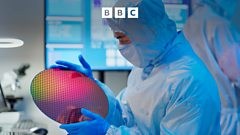
Lead: In a significant leap for semiconductor technology, researchers are now developing chips that are not only thinner but also flexible, diverging from the rigid silicon foundations that have dominated electronics for decades. This evolution, reported by BBC News, signals a shift in how computing components are engineered, with potential applications in wearable devices, medical sensors, and compact consumer electronics.
The traditional silicon chip has been the backbone of modern computing since the 1960s. Its durability, scalability, and well-established manufacturing processes have made it the standard for processors, memory units, and integrated circuits. However, silicon's physical limitations—such as its rigidity and difficulty in being bent or folded—have long constrained the design possibilities for next-generation devices.
From Silicon to Flexible Materials
While silicon remains dominant in high-performance computing, new materials are being explored to overcome its mechanical constraints. The BBC News report highlights that the next generation of chips is being developed using thin-film technologies and flexible substrates. These materials allow chips to be manufactured on flexible plastic or polymer bases, enabling them to conform to irregular surfaces or be integrated into bendable devices.
These flexible chips are not merely thinner versions of silicon chips; they represent a fundamental change in design philosophy. Instead of relying on rigid silicon wafers, engineers are now using layered materials such as gallium nitride, graphene, or organic semiconductors. These alternatives offer better mechanical flexibility and can be processed at lower temperatures, reducing energy consumption during fabrication.
One of the key advantages of flexible chips is their ability to be embedded in non-traditional forms. For instance, a chip could be printed directly onto a fabric surface or integrated into a curved surface of a smartwatch or medical patch. This opens the door to new product categories that were previously impractical due to the rigidity of conventional chips.
Current Applications and Limitations
As of now, flexible chips are primarily used in niche applications. The BBC News report does not specify any commercial products or widespread deployments, indicating that the technology is still in the experimental or prototype phase. Early implementations include flexible sensors for health monitoring, such as wearable patches that detect heart rate or body temperature, and prototypes for foldable smartphones or rollable displays.
Despite their promise, flexible chips face several technical challenges. One major issue is signal integrity—maintaining stable data transmission across a flexible surface that may stretch or bend. Additionally, heat dissipation remains a concern, as flexible materials often have lower thermal conductivity than silicon, which can lead to overheating in high-performance applications.
Manufacturing scalability is another hurdle. While silicon chips benefit from decades of investment in production infrastructure, flexible chip fabrication requires new equipment and processes. Current production lines are not optimized for these materials, and the cost of producing high-quality flexible chips remains significantly higher than traditional silicon chips.
Scientific Foundations and Material Science
The development of flexible chips is rooted in advances in material science. Researchers have been investigating organic semiconductors—carbon-based materials that can be deposited in thin layers—and exploring the use of 2D materials like graphene, which has exceptional electrical properties and mechanical flexibility.
Graphene, in particular, has been studied for its potential to serve as a base layer for flexible electronics. It is a single layer of carbon atoms arranged in a hexagonal lattice, offering high electron mobility and mechanical strength. However, challenges remain in achieving large-scale, defect-free graphene production and integrating it into functional circuits.
Another approach involves using thin-film transistors (TFTs) fabricated on plastic substrates. These components are already used in displays for TVs and monitors, but their application in full computing chips—such as processors or memory units—is still under development. The BBC report does not provide details on specific research institutions or breakthroughs, but it confirms that progress is being made in laboratory settings.
Timeline and Research Progress
There is no publicly available timeline in the BBC report specifying when flexible chips will transition from lab prototypes to mass production. The development of such chips is a long-term process, involving multiple stages of research, testing, and iteration. Most current work is conducted in academic laboratories or specialized R&D centers, with limited industrial involvement.
For example, institutions such as the University of Cambridge and the University of Tokyo have published research on flexible electronics, but these studies remain focused on proof-of-concept devices. No commercial product has been released that uses a fully functional, flexible silicon-like chip in a consumer device as of the date of the BBC report.
While there are no specific dates mentioned, the progression of flexible chip technology is likely to follow a gradual path. Early adoption may occur in medical devices, where flexibility allows for better patient comfort and integration with skin. Over time, the technology could expand into consumer electronics, such as smart clothing or foldable tablets.
Implications for the Electronics Industry
If flexible chips become viable at scale, they could disrupt the current electronics ecosystem. The traditional model of rigid, flat chips on silicon wafers may give way to a new paradigm where devices are designed with form and function in mind, rather than being constrained by physical dimensions.
Manufacturers may need to reevaluate their supply chains, design processes, and product development cycles. For instance, companies that produce smartphones or smartwatches may begin to prioritize flexible chip integration to improve user experience and device durability.
However, the transition will not be immediate. The industry still relies heavily on silicon for performance, power efficiency, and reliability. Flexible chips are unlikely to replace silicon in high-performance computing applications such as data centers or gaming consoles, where heat management and processing power are critical.
Challenges and Future Outlook
Despite the potential, several challenges remain. First, the long-term stability of flexible materials under varying environmental conditions—such as temperature, humidity, and mechanical stress—is not yet fully understood. Second, the integration of flexible chips with existing systems, including power supplies and cooling mechanisms, requires new engineering solutions.
Additionally, there is a lack of standardized protocols for flexible chip design and testing. Without industry-wide standards, innovation may remain fragmented, with different companies developing incompatible technologies.
Looking ahead, the future of flexible chips may lie in hybrid systems—devices that combine rigid silicon components with flexible layers for specific functions. For example, a smartwatch might use a silicon processor for core operations and a flexible sensor layer for health monitoring. This hybrid approach could offer the best of both worlds: performance and flexibility.
While the BBC report does not provide data on market projections or investment trends, the growing interest in flexible electronics suggests that this field is gaining momentum. Research funding from governments and private sectors is increasing, particularly in areas related to wearable technology and health monitoring.
Ultimately, the next generation of chips represents more than a technical upgrade—it reflects a broader shift in how we think about electronic devices. Instead of viewing them as rigid, box-shaped objects, future devices may be designed as part of a user’s environment, conforming to their bodies or surroundings.
As material science continues to advance, the line between traditional silicon and flexible electronics may blur. But until then, the technology remains a promising frontier, still in its early stages of development and application.