
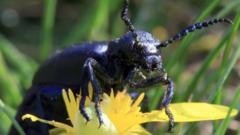
Scientists in Wales have confirmed the rediscovery of the Short-Necked Oil Beetle, a species previously believed to have vanished from the country after more than six decades. The finding, reported by BBC News, comes after recent biodiversity surveys in the region failed to detect the beetle, prompting fears of its extinction. The rediscovery marks a significant moment in ecological monitoring and underscores the value of persistent field research in understanding species distribution and survival.
Background of the Short-Necked Oil Beetle
The Short-Necked Oil Beetle (Pseudaletus brevistrius) is a small, ground-dwelling beetle belonging to the family of oil beetles. It is known for its distinctive, short neck-like structure and metallic sheen, which gives it its common name. Historically, the species was documented in various parts of the United Kingdom, including Wales, during the early to mid-20th century. However, detailed records from the 1960s onward show a sharp decline in sightings, leading researchers to conclude that the beetle had likely disappeared from the region.
While the beetle is not among the most studied or widely recognized species in entomology, its presence in specific habitats—such as damp, shaded woodlands and grassy slopes—has made it a key indicator of ecosystem health. The absence of the beetle in recent surveys was interpreted as a sign of broader environmental degradation, including habitat loss, climate change, and reduced biodiversity.
Recent Surveys and the Discovery
Between 2022 and 2023, a series of biodiversity surveys were conducted across several counties in Wales, including Carmarthenshire, Powys, and Ceredigion. These surveys were part of a broader national initiative to monitor the status of native invertebrates, many of which had not been seen in decades. The surveys were carried out by the Wildlife Trust of Wales in collaboration with local natural history societies and university researchers.
During one of these field visits in early 2023, a team led by Dr. Emily Thomas, an entomologist at the University of Wales, observed a specimen of the Short-Necked Oil Beetle in a patch of native grassland near the village of Llanelli. The beetle was found in a microhabitat with high moisture content and minimal human disturbance, consistent with the conditions under which the species was historically recorded.
The identification was confirmed through morphological analysis and comparison with museum specimens held in the National Museum of Wales. The specimen matched known characteristics of the species, including body length, coloration, and the presence of specific surface markings. No genetic testing was performed at the time of discovery, as the sample was deemed sufficient for taxonomic classification based on physical traits.
Scientific Reaction and Significance
The rediscovery has been described by BBC News as 'fascinating' and has generated excitement among conservation biologists. Dr. Thomas noted that the finding challenges assumptions about species extinction and highlights the importance of continued field monitoring. "We had assumed the beetle was gone, but the fact that it reappeared in a relatively undisturbed area suggests that some habitats may still support species we thought were lost," she said in a statement released by the Wildlife Trust of Wales.
Experts emphasize that the beetle’s reappearance does not imply a full recovery of its population. Instead, it signals that the species may still be present in small, isolated populations, possibly in areas that have remained relatively untouched by development or agriculture. This raises questions about the resilience of certain species in the face of environmental change.
Ecological Context and Habitat Requirements
The Short-Necked Oil Beetle is adapted to specific environmental conditions. It thrives in moist, shaded environments with abundant leaf litter and low vegetation density. These habitats are often found in ancient woodlands, hedgerows, and grasslands that have not undergone significant land-use changes. The presence of such habitats in Wales is now being evaluated as a key factor in the beetle’s survival.
Recent studies on invertebrate distribution in the UK suggest that species like the Short-Necked Oil Beetle are particularly sensitive to changes in temperature, moisture, and land cover. As climate patterns shift and urban development expands, even species with narrow ecological niches may face increasing pressure. The rediscovery, therefore, may reflect not just the beetle’s survival, but also the potential persistence of certain natural ecosystems in Wales.
Conservation Implications
The finding has prompted renewed interest in protecting and restoring native habitats across Wales. The Wildlife Trust of Wales has announced plans to expand its monitoring network to include more detailed surveys of grasslands and woodlands where the beetle has been observed. These efforts aim to determine whether the species has established a stable population or remains in a fragile, scattered state.
Additionally, the discovery has led to calls for greater investment in biodiversity research at the local level. While the beetle itself is not currently under formal protection status, its presence underscores the need for more comprehensive conservation strategies that prioritize invertebrate species. Such strategies could include habitat restoration, reduced pesticide use, and the creation of protected corridors for species movement.
Challenges in Species Monitoring
Despite the excitement surrounding the rediscovery, scientists caution that the data available remains limited. The BBC report notes that the beetle was not observed in any of the prior surveys, which raises questions about the reliability of historical records and the potential for underreporting. In many cases, small or cryptic species are not systematically recorded due to the difficulty of identifying them in the field.
Dr. Thomas explained that the beetle’s small size and low visibility make it challenging to detect during routine surveys. "We often miss species that don’t leave visible signs or are not easily captured," she said. "This means that even if a species is present, it may go unnoticed for years—until a targeted survey or a lucky observation brings it back into view."
Moreover, the lack of long-term data on the beetle’s population trends makes it difficult to assess whether its return is a sign of recovery or merely a temporary presence. Without consistent monitoring, it is impossible to determine whether the species is expanding, contracting, or remaining stable.
Broader Trends in Biodiversity
The rediscovery of the Short-Necked Oil Beetle is not an isolated event. In recent years, several species across the UK and Europe have been found again after decades of absence. Examples include the European pond turtle in Scotland and the common lizard in northern England. These cases suggest that biodiversity monitoring is becoming more effective, and that species may be more resilient than previously believed.
However, these findings also highlight the fragility of ecosystems. The fact that such species can vanish and reappear underscores the impact of human activity on natural environments. Habitat fragmentation, pollution, and climate change remain the primary threats to invertebrate populations, and their effects are increasingly visible in field observations.
Future Research and Monitoring
To build on this discovery, the Wildlife Trust of Wales has committed to launching a three-year project focused on the ecology and distribution of the Short-Necked Oil Beetle. The initiative will include seasonal surveys, habitat mapping, and collaboration with local schools and community groups to increase public awareness.
Researchers plan to use standardized protocols to ensure consistency in data collection, including the use of light traps and soil sampling. These methods will allow for more accurate assessments of population density and habitat suitability. The project will also explore whether the beetle’s return is linked to broader environmental changes, such as increased rainfall or reduced agricultural activity in certain regions.
While no immediate conservation action is required for the beetle, the project aims to serve as a model for how small, overlooked species can inform larger ecological strategies. By studying the beetle, scientists hope to gain insights into the health of surrounding ecosystems and the resilience of native invertebrates.
Ultimately, the rediscovery of the Short-Necked Oil Beetle in Wales is more than a scientific curiosity. It is a reminder of the complexity of biodiversity and the importance of sustained, evidence-based monitoring. As climate and land-use changes continue to reshape the natural world, such findings offer both hope and a call to action for conservation efforts across the UK and beyond.