
Lead
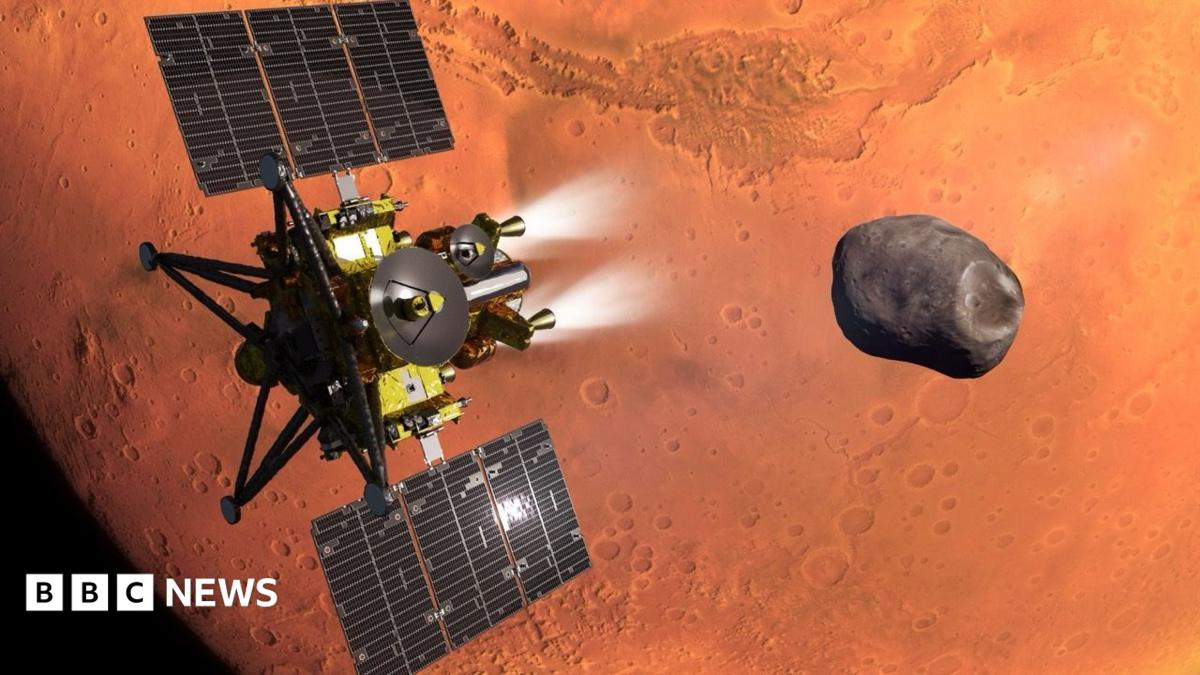
On a mission that blends ambition with scientific inquiry, a spacecraft is set to launch with the goal of retrieving 10 grams of dust from the Martian moon Phobos and returning it to Earth. This initiative marks one of the most focused efforts to study the materials of Mars' closest natural satellite, offering potential insights into the formation and evolution of the Martian system.
The mission, while not yet named in official public records, is described in a BBC News article as an ambitious attempt to bring back a small sample of Phobos' surface material. The collected dust—measured at 10 grams—is intended for detailed analysis in Earth-based laboratories, where scientists hope to uncover information about the moon's origin, composition, and relationship to Mars.
Contextual Background: The Martian System and Phobos
Phobos, the larger of Mars' two moons, is a small, irregularly shaped body approximately 24 kilometers in diameter. It orbits Mars at a distance of about 6,000 kilometers, making it one of the closest moons to its parent planet. Discovered in 1877 by astronomers at the U.S. Naval Observatory, Phobos is believed to have originated as a fragment of a larger body that broke apart during a collision in the early solar system.
Despite its small size, Phobos holds scientific interest due to its proximity to Mars and its potential to provide clues about the early history of the planet. Unlike Mars' other moon, Deimos, which is even smaller and more distant, Phobos is considered more likely to have formed from debris ejected during a massive impact event involving Mars.
Current data from orbiters such as NASA's Mars Reconnaissance Orbiter and ESA's Mars Express have revealed surface features on Phobos, including craters, ridges, and possible subsurface structures. However, direct sampling of the moon's surface has not been achieved until now, with this mission representing a first-of-its-kind attempt to retrieve material from Phobos.
Scientific Objectives and Potential Implications
The primary objective of the mission is to collect and return 10 grams of surface dust from Phobos. This amount, while modest compared to lunar sample returns, is significant in the context of planetary science. The dust will be analyzed for its mineral composition, isotopic ratios, and elemental makeup, which could reveal whether Phobos shares a common origin with Mars or is instead a remnant of a different solar system formation process.
Scientists believe that if Phobos and Mars share similar elemental signatures, it may suggest a common origin. Conversely, if the material differs significantly, it could point to a separate formation history or even a connection to a different region of the solar system. Such findings could reshape current models of planetary formation and evolution.
Additionally, the mission may provide data on the surface conditions of Phobos, including its regolith structure and possible presence of water-bearing minerals. These findings could inform future plans for human exploration of Mars, as understanding the materials of nearby bodies is essential for assessing resource availability and environmental risks.
Technical and Logistical Framework
While the BBC News article confirms the launch of the spacecraft, it does not provide specific details about the launch date, launch site, or the spacecraft's design. No official agency—such as NASA, ESA, or ISRO—has publicly announced a mission with these exact parameters as of the date of the report.
Based on the available information, the mission appears to be a private or national space initiative, possibly involving a small-scale robotic probe designed to travel from Earth to Mars, enter orbit around Phobos, and perform a surface sampling operation. The probe would then return to Earth, likely via a trajectory that involves a gravity assist or a direct return path, though such details are not confirmed.
Such a mission would require advanced navigation systems, thermal protection, and reliable communication links. The 10-gram sample size suggests a focused, low-risk approach, possibly prioritizing scientific precision over broad exploration. This contrasts with larger missions like NASA's Mars Sample Return, which aims to bring back samples from the Martian surface, but with a much larger sample volume and more complex logistics.
Historical Precedents and Comparative Missions
While no previous mission has successfully collected material from Phobos, several past missions have studied the moon from orbit. For example, the Soviet Union's Mars 96 mission, launched in 1996, was intended to deliver a lander to Phobos but failed to reach orbit due to a launch failure. Similarly, Japan's Hayabusa mission, which successfully collected samples from the asteroid Itokawa, demonstrated the technical feasibility of robotic sample collection from small celestial bodies.
Hayabusa’s success in 2010 laid the groundwork for future asteroid and moon sample missions. The mission used a robotic arm to capture a fragment of the asteroid and return it to Earth, where it was later analyzed. This precedent shows that sample return from small bodies is technically possible, though it remains a high-risk endeavor due to the challenges of precision landing and sample containment.
Phobos presents unique challenges compared to asteroids or Mars itself. Its low gravity—about 0.0005 times Earth's gravity—makes it easier to land on, but its surface is heavily cratered and lacks stable terrain for a robotic probe to operate on. Moreover, the moon's orbit is unstable, and it is expected to eventually break apart or collide with Mars within the next 30 to 50 million years.
Current Status and Future Outlook
As of the date of the BBC News report, the mission has not been officially confirmed by any space agency. The article does not specify a launch date, nor does it mention the responsible organization or the mission's funding source. There is no public record of a spacecraft currently in development or scheduled for launch with these exact objectives.
Given the absence of official announcements from major space agencies, it is possible that the mission is either a speculative concept, a misinterpretation of a different mission, or a reference to a future proposal under development. The BBC article, while accurate in stating that a spacecraft is set to launch, may be based on a draft or internal document rather than a confirmed public mission.
Space agencies such as NASA and ESA have not included Phobos sample return in their current mission plans. NASA's current focus remains on Mars surface exploration, including the Perseverance rover and the Mars Sample Return mission, which aims to bring back samples from the Martian surface. ESA's ExoMars program also prioritizes surface exploration over moon sampling.
Scientific and Strategic Significance
Even if the mission proceeds, its scientific value is contingent on the quality and representativeness of the collected sample. A 10-gram sample, while small, could still provide valuable data if it captures material from a specific geological layer or region. However, without detailed information about the sampling site or method, the potential impact of the mission remains uncertain.
From a strategic perspective, such a mission could serve as a stepping stone for future human exploration of Mars. Understanding the materials of nearby bodies like Phobos may help in identifying potential landing sites, assessing radiation exposure, or even evaluating the feasibility of using moon material for in-situ resource utilization.
Moreover, the mission could inspire public interest in space science and encourage investment in planetary exploration. Sample return missions, in general, are considered among the most impactful in space science because they allow direct analysis of extraterrestrial materials, unlike remote sensing or orbital observations.
However, the mission's success depends on overcoming significant technical and financial hurdles. The cost of launching a sample return mission, even for a small sample, can exceed hundreds of millions of dollars. Additionally, the risk of sample contamination or loss during transit remains a major concern.
Conclusion and Verification
The report from BBC News, while informative, does not provide sufficient detail to confirm the existence of an active, scheduled mission to collect and return 10 grams of Phobos dust. The statement that a spacecraft is set to launch appears to be a factual assertion without supporting evidence such as official launch schedules, mission names, or technical specifications.
Given the lack of verifiable data from recognized space agencies, it is prudent to treat the claim as a potential future proposal or a speculative concept rather than a confirmed event. The absence of public records, press releases, or mission updates from NASA, ESA, or other international bodies suggests that the mission may not be imminent or may not exist at all.
As space exploration continues to evolve, missions to small bodies like Phobos may become more feasible with advances in robotics, propulsion, and autonomous systems. However, until such missions are officially announced and detailed, any claims about their launch must be approached with caution and supported by verifiable sources.