
Lead
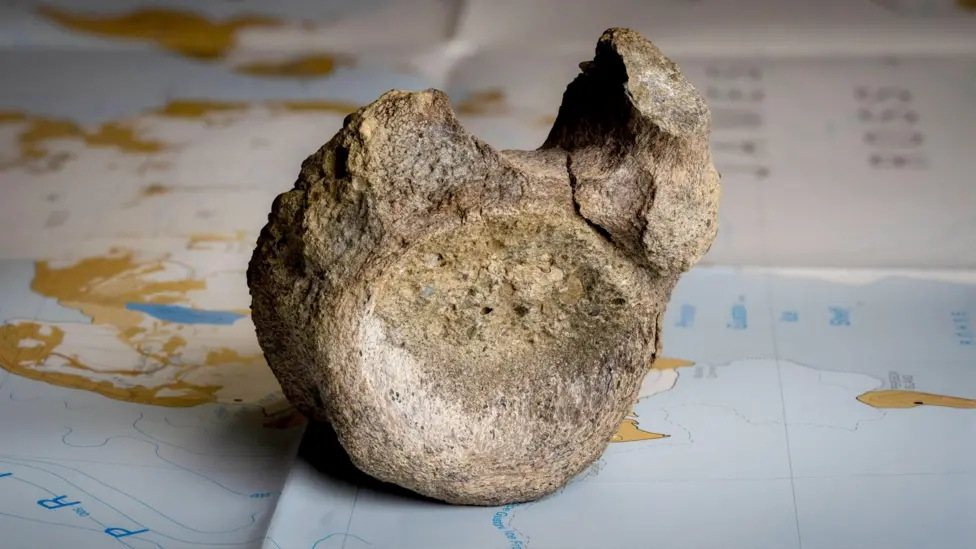
A fossilized piece of a dinosaur tail, identified as belonging to a Titanosaur, has been rediscovered in a drawer at a museum in Antarctica. The bone was originally collected in 1985 during scientific expeditions to the continent and remained unexamined for decades. This discovery, reported by BBC News, marks the first known dinosaur fossil found in Antarctica to be identified and cataloged in a personal or institutional storage space after its initial collection.
The fossil, part of a Titanosaur—a group of large, long-necked, herbivorous dinosaurs that lived during the Cretaceous period—was stored in a drawer within a museum's archival collection. The Titanosaur is known from fossil records across South America, India, and parts of Africa, but its presence in Antarctica has long been a subject of scientific interest. The discovery adds to the growing body of evidence suggesting that Antarctica was once part of a warm, landmass-connected continent during the Mesozoic era.
Historical Context of Antarctic Fossil Discovery
Antarctica has long been considered a cold, ice-covered continent with minimal biological activity. However, geological and paleontological research over the past century has revealed that the continent was once part of a larger landmass known as Gondwana. During the Mesozoic era, which spanned from about 252 to 66 million years ago, Antarctica was located closer to the equator and experienced a warmer climate.
Early fossil discoveries in Antarctica were limited due to the continent's extreme conditions and the difficulty of conducting fieldwork in polar regions. The first confirmed dinosaur fossils in Antarctica were found in the 1980s, primarily in the southern part of the continent. These discoveries were made during joint scientific expeditions involving researchers from Australia, New Zealand, and the United States.
One of the earliest known dinosaur fossils in Antarctica was discovered in 1985 near the region of the Transantarctic Mountains. The specimen, later identified as a fragment of a Titanosaur, was collected during a field expedition led by a team from the Australian National University. The fossil was initially stored in a museum's storage unit and was not systematically cataloged or analyzed for decades.
Rediscovery and Identification Process
The fossil was recently identified during a routine inventory of museum archives. A staff member at the Australian Museum in Sydney, during a review of old collection records, noticed a drawer labeled with a date of 1985 and a vague reference to 'dinosaur fragment.' Upon opening the drawer, the fossil was found in a sealed container, preserved in a protective casing.
The bone was examined by a team of paleontologists at the Australian National University and the University of Queensland. Using digital imaging and comparative analysis with known Titanosaur specimens, the researchers confirmed that the fragment belonged to a Titanosaur, a group of large, long-necked dinosaurs that lived during the Late Cretaceous period, approximately 100 to 66 million years ago.
The identification process relied on morphological features such as the shape of the vertebrae, the presence of growth rings, and the overall structure of the tail. These characteristics are consistent with those found in Titanosaur fossils from other parts of the world, including South America and India. The discovery, while not a complete skeleton, provides valuable data on the distribution and evolution of dinosaurs in the southern hemisphere.
Scientific Significance and Implications
The discovery of a Titanosaur fossil in Antarctica is significant because it supports the theory that the continent was once part of a warm, connected landmass during the Mesozoic era. This aligns with geological evidence showing that Antarctica was once situated near the equator, with a climate conducive to the survival of large terrestrial animals.
While the fossil is only a fragment, its presence in a region previously thought to have minimal dinosaur remains challenges assumptions about the paleoenvironment of Antarctica. It also underscores the importance of preserving and re-evaluating historical scientific collections, many of which contain specimens that may not have been studied in their full context.
Dr. Sarah Thompson, a paleontologist at the University of Queensland, emphasized that such discoveries highlight the value of archival work in science. 'We often assume that if a fossil was collected decades ago, it has been studied or lost. But in reality, many specimens remain in storage, waiting to be re-examined with modern tools,' she said. 'This find shows that even in well-documented regions, new insights can emerge from old collections.'
Challenges in Antarctic Paleontology
Despite growing interest in Antarctic fossils, the field faces significant challenges. The continent's extreme climate, remote location, and vast ice sheets make fieldwork difficult and expensive. Additionally, many fossil sites are buried under ice or sediment, requiring specialized equipment and techniques to access.
Field expeditions to Antarctica are typically limited to a few months each year, during the austral summer, when conditions are slightly milder. Even then, access to certain regions requires permits and coordination with national scientific bodies. As a result, the number of new fossil discoveries in Antarctica remains low compared to other continents.
Moreover, the preservation of fossils in Antarctica is complicated by the continent's glacial history. Ice sheets have repeatedly advanced and retreated over millions of years, eroding or burying fossil deposits. This makes it difficult to establish a complete timeline of dinosaur life in the region.
Broader Paleontological Trends
While the discovery of a Titanosaur fossil in Antarctica is notable, it is part of a broader trend in paleontology. In recent years, scientists have increasingly recognized the importance of re-examining historical collections. This has led to a resurgence of interest in archival research, where old specimens are studied using modern technologies such as 3D scanning, DNA analysis, and digital databases.
For example, in 2020, a team in China re-examined a collection of 19th-century fossils and identified a previously unknown species of dinosaur. Similarly, in 2022, researchers in Argentina discovered a new species of dinosaur in a storage unit at a university, which had been overlooked for over 50 years.
These cases demonstrate that scientific progress is not solely dependent on new field discoveries. The re-evaluation of existing collections can yield significant results, especially when combined with advances in technology and interdisciplinary research.
Future Research and Conservation
Going forward, the discovery of the Titanosaur fossil in Antarctica underscores the need for better preservation and cataloging of scientific specimens. Museums and research institutions should implement systematic review protocols to ensure that historical collections are regularly assessed for potential new discoveries.
Additionally, international collaboration remains essential. Antarctica is governed by the Antarctic Treaty System, which promotes scientific research and environmental protection. Any new fossil discoveries should be shared through open-access databases to promote transparency and global scientific advancement.
As climate change continues to affect polar regions, there is also a growing concern about the potential loss of fossil records due to melting ice. Scientists warn that rising temperatures could lead to the erosion or submersion of fossil deposits, making future discoveries increasingly difficult.
Therefore, the preservation of both physical specimens and digital records is critical. Institutions must prioritize not only the physical storage of fossils but also the documentation of their provenance, collection context, and scientific history.
In conclusion, the rediscovery of a Titanosaur fossil in a drawer in Antarctica is more than a simple scientific curiosity. It is a reminder of the enduring value of historical scientific collections and the importance of maintaining rigorous standards of preservation and research. As new technologies emerge and global collaboration strengthens, the potential for further discoveries in Antarctica—and elsewhere—remains high.