
Lead
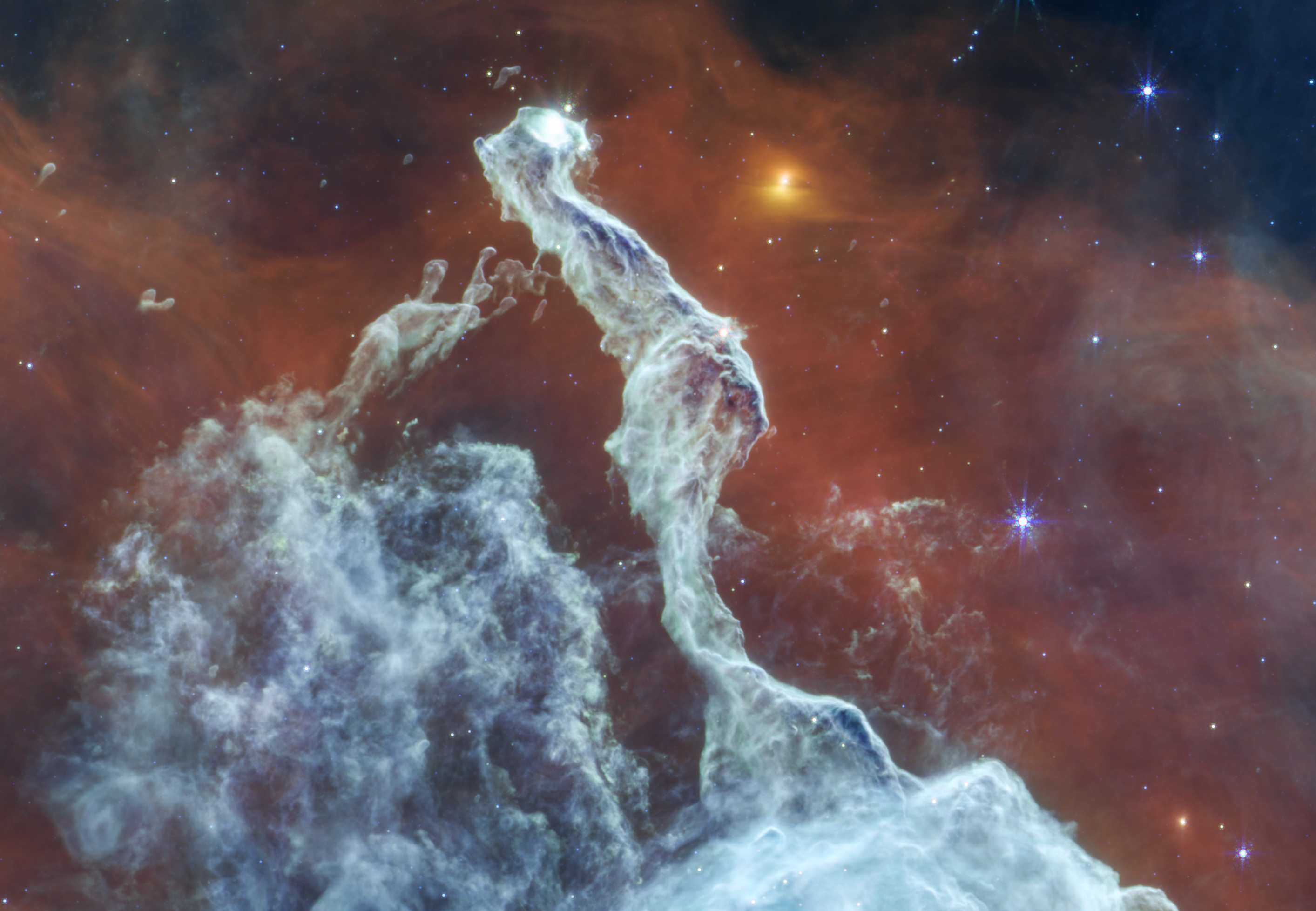
On October 29, 2026, NASA released a mid-infrared image of the Cat’s Head Nebula captured by the James Webb Space Telescope (JWST). The image, part of a broader set of observations of the Carina Nebula, showcases the nebula’s striking resemblance to a feline head, with prominent ridges and a central peak. The image was made available through NASA’s official website and is part of the telescope’s ongoing mission to study star formation in deep space.
Origins of the Cat’s Head Nebula
The Cat’s Head Nebula, officially designated as NGC 3136, is a region of interstellar gas and dust located approximately 7,500 light-years from Earth in the constellation Carina. It lies within the larger Carina Nebula, one of the most active star-forming regions in our galaxy. The nebula’s name was coined by astronomers in the 1960s due to its visual similarity to a cat’s head when viewed in optical wavelengths.
While the name is informal and descriptive, the structure of the nebula has long been studied for its complex morphology. The central peak and surrounding ridges suggest that the region has undergone significant physical transformation over millions of years. The current image from the James Webb Space Telescope provides a new perspective, capturing the nebula in mid-infrared light, which reveals different physical properties than visible light.
How the Nebula Was Shaped
According to NASA, the distinctive shape of the Cat’s Head Nebula was likely sculpted over time by intense ultraviolet radiation and powerful stellar winds emanating from massive stars in the Carina Nebula. These stars, which can be up to 20 times more massive than the Sun, emit high-energy radiation that ionizes nearby gas and dust, causing it to glow and form visible structures.
Stellar feedback—such as radiation pressure and wind—acts as a force that can both trigger and suppress star formation. In the case of the Cat’s Head Nebula, the radiation and winds appear to have carved out the current structure, eroding material from the surrounding interstellar medium. This process is a key mechanism in understanding how star-forming regions evolve over time.
James Webb Space Telescope’s Role
The James Webb Space Telescope, launched in 2021 and positioned at the second Lagrange point (L2), has been instrumental in observing the universe in infrared wavelengths. Unlike visible light, infrared radiation penetrates dust and gas more effectively, allowing astronomers to peer into dense regions of space where stars are forming.
The mid-infrared view of the Cat’s Head Nebula was captured using the telescope’s Near-Infrared Camera (NIRCam) and the Mid-Infrared Instrument (MIRI). These instruments detect light in the 5 to 24 micrometer range, which is particularly useful for observing warm dust and molecular gas. The image reveals fine details that are not visible in optical observations, such as the internal filaments and thermal gradients within the nebula.
Scientific Significance of the Observation
The release of this image marks a significant milestone in the study of interstellar structures. While the Cat’s Head Nebula has been known for decades, the ability to observe it in mid-infrared light provides new data on the temperature, density, and composition of the gas and dust within it.
Scientists believe that such observations can help refine models of how massive stars influence their surroundings. The interaction between massive stars and their environment is a critical factor in galactic evolution, and the Cat’s Head Nebula serves as a natural laboratory for studying these processes.
Context Within the Carina Nebula
The Carina Nebula is one of the most prominent star-forming regions in the Milky Way. It spans about 300 light-years and contains numerous young stars, including massive O-type and B-type stars. These stars are responsible for much of the radiation and wind that shape nearby nebulae.
Within the Carina Nebula, several other structures have been identified, such as the Pillars of Creation and the Eridanus Rift. The Cat’s Head Nebula is one of several features that demonstrate how massive stars can sculpt their environment. This observation adds to a growing body of evidence that stellar feedback plays a central role in regulating star formation across galaxies.
Limitations and Interpretations
It is important to note that the image does not show a literal cat or any biological entity. The name 'Cat’s Head' is purely a visual metaphor and has no connection to animal life. The nebula is composed entirely of interstellar gas and dust, with no organic matter or life forms present.
While the image is visually striking, it does not provide new data on the origin of the nebula’s shape beyond what is already known from previous observations. The shape is still interpreted as a result of physical processes, not an artifact of chance or design. The use of the name 'Cat’s Head' remains a descriptive label, not a scientific classification.
Public Engagement and Media Impact
The release of the image coincided with a broader public outreach campaign by NASA to promote the James Webb Space Telescope’s capabilities. The image was shared widely across social media platforms and science communication channels, generating significant public interest.
Many users interpreted the image as a representation of the universe’s mysterious and artistic nature. However, NASA emphasized that the image is a scientific observation, not a work of art or a metaphor for intelligence or consciousness. The agency has consistently maintained that all astronomical images are products of physical processes, not symbolic representations of life or intelligence.
Future Observations and Research
Scientists plan to conduct follow-up observations of the Cat’s Head Nebula using the James Webb Space Telescope over the coming years. These observations will focus on measuring the temperature distribution, chemical composition, and velocity of gas within the nebula.
By combining infrared data with data from other telescopes—such as the Hubble Space Telescope and ground-based observatories—researchers hope to build a more complete picture of how massive stars influence their surroundings. This will help refine models of star formation and galactic evolution.
Broader Implications for Astronomy
The Cat’s Head Nebula observation underscores the importance of multi-wavelength astronomy. By observing celestial objects across different parts of the electromagnetic spectrum, scientists can gain a more comprehensive understanding of physical processes in space.
As more data becomes available from the James Webb Space Telescope, astronomers will be able to identify patterns in how stars and nebulae interact. These patterns may eventually help explain large-scale phenomena such as galaxy formation and the distribution of matter in the universe.
Conclusion
The mid-infrared image of the Cat’s Head Nebula from NASA’s James Webb Space Telescope is a powerful example of how modern astronomy combines advanced technology with scientific inquiry. While the image is visually compelling, its value lies in the physical insights it provides into the processes that shape the interstellar medium.
As the James Webb Space Telescope continues its mission, it will likely reveal more such structures, offering new perspectives on the dynamic nature of our galaxy. The Cat’s Head Nebula, though named for its appearance, remains a testament to the power of natural processes in shaping the cosmos—without any connection to biological life or intelligence.