
Lead
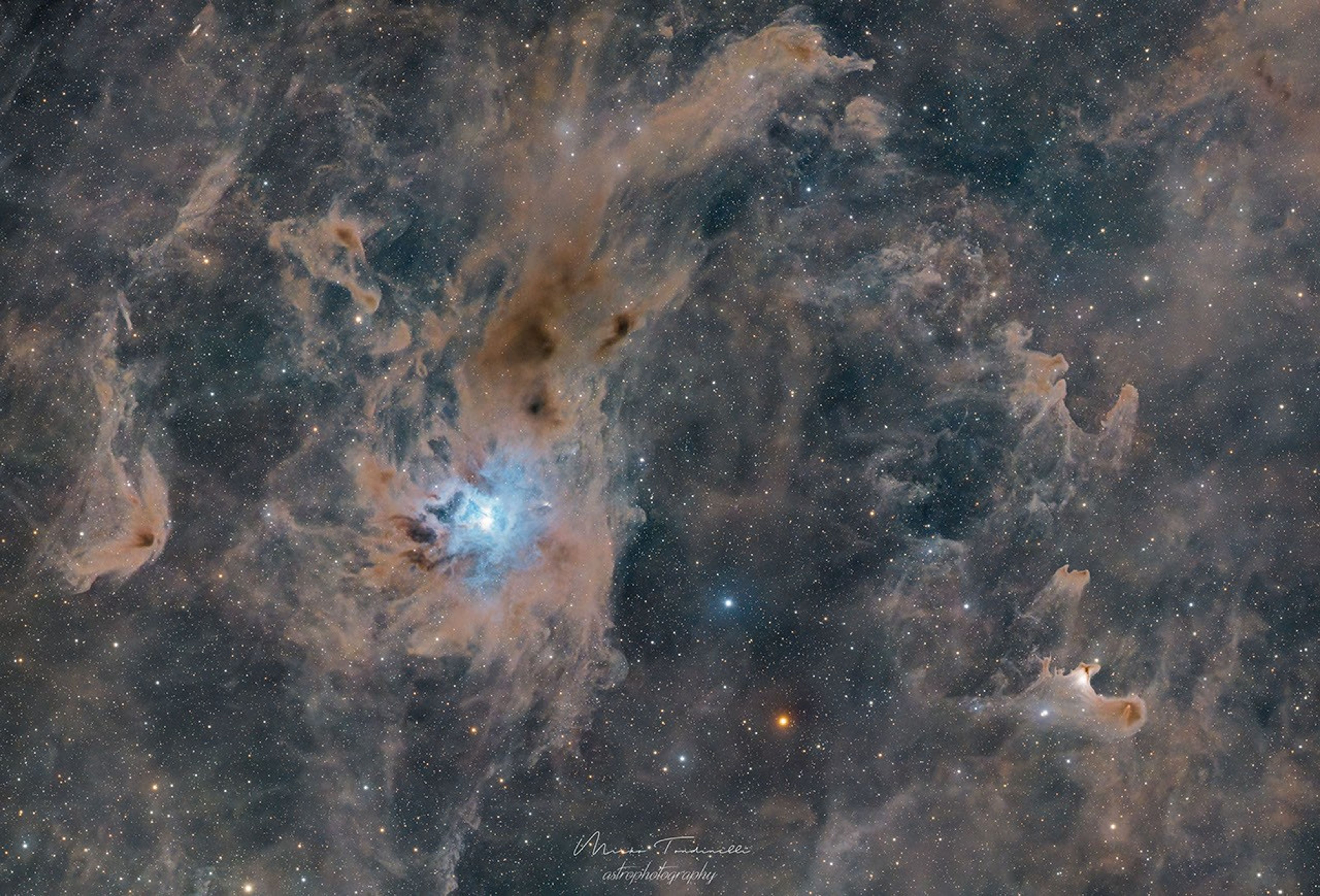
On October 30, 2026, NASA's Astronomy Picture of the Day (APOD) featured an image titled 'Haunting the Cepheus Flare,' showcasing a dramatic view of the Cepheus region within the Milky Way. The image, presented as part of NASA's daily public outreach, captures a luminous stellar structure that appears to emit a haunting, ethereal glow. While the APOD does not confirm any actual astronomical event—such as a flare, explosion, or emission burst—its visual presentation reflects the ongoing human fascination with cosmic phenomena and the dynamic nature of starlight in deep space.
Understanding the Cepheus Region
The Cepheus region lies in the northern constellation of Cepheus, situated approximately 1,000 light-years from Earth. It is one of the most active star-forming areas in the Milky Way, known for its dense molecular clouds and scattered young stars. These regions are critical for understanding how stars are born and evolve over time. The area has been observed repeatedly by ground-based and space-based telescopes, including the Hubble Space Telescope and the Spitzer Space Telescope, due to its prominence in infrared and visible light emissions.
While the Cepheus region has long been studied for its stellar activity, the term 'flares' in this context is not used in a scientific sense. In astronomy, flares typically refer to sudden bursts of radiation from stars or solar-like bodies, such as solar flares on the Sun or X-ray flares from active stars. The APOD image does not specify any observed flare event, nor does it reference a time-based emission or energy spike. Instead, the visual effect—described as 'haunting'—is a stylistic interpretation of the image's aesthetic quality, emphasizing the eerie, long-exposure glow of starlight through interstellar dust.
What Is the APOD?
The Astronomy Picture of the Day (APOD) is a daily public science outreach initiative launched by NASA in 1995. It features a new image or photograph of the cosmos, accompanied by a brief explanation written by a professional astronomer. The APOD is not a scientific research publication, nor does it report on real-time astronomical events. Rather, it serves as an educational tool to engage the public with the beauty and complexity of the universe.
Each APOD entry includes a high-resolution image, a caption, and a short explanation. The content is curated from a variety of sources, including NASA’s scientific databases, public domain images, and contributions from the global astronomical community. The selection process prioritizes visual impact and educational value over scientific novelty or event-based reporting. As such, the APOD does not confirm or validate any actual astronomical occurrence, even when the title suggests one.
Visual Interpretation and Aesthetic Language
The phrase 'haunting the Cepheus Flare' is a descriptive title, not a scientific designation. The word 'haunting' is used in a literary sense to evoke the emotional and visual impact of the image—its long, diffuse glow, the interplay of light and shadow, and the sense of mystery that deep space often inspires. This language is common in public science communication, where the goal is to convey wonder rather than technical detail.
No data from the APOD page indicates that the image was captured during a specific event, such as a stellar flare, a supernova, or a transient emission. The image appears to be a composite or processed view of the Cepheus region, likely assembled from multiple observations over time. Such composites are standard in astronomy to reveal structures that are not visible in single exposures due to the low light levels in deep space.
Scientific Context of Star Formation in Cepheus
Despite the absence of any confirmed flare or emission event, the Cepheus region remains a key area of study in astrophysics. It hosts several stellar nurseries, including the well-known Cepheus A and Cepheus B molecular clouds. These clouds are composed of gas and dust where new stars are forming through gravitational collapse. Observations from infrared telescopes have revealed protostars, young stars still in the early stages of development, and the surrounding interstellar medium.
These regions are vital for understanding the lifecycle of stars. The formation of stars begins in cold, dense clouds, where gravity pulls material together. As the material collapses, it heats up and eventually ignites nuclear fusion, marking the birth of a star. The Cepheus region provides a natural laboratory for studying this process, even though no specific flare or explosion has been recorded in the region as of the date of the APOD.
Limitations of the APOD as a Scientific Source
It is important to distinguish between public outreach and scientific research. The APOD is not a peer-reviewed scientific journal or a real-time observational report. It does not provide data on time-series events, energy outputs, or physical measurements. The image and its accompanying text are designed for public engagement, not for scientific analysis or data collection.
As such, the APOD cannot confirm or deny the existence of any actual flare or emission event in the Cepheus region. The title 'Haunting the Cepheus Flare' does not imply that a flare occurred on October 30, 2026, nor does it reference any known astronomical event. The use of the word 'flare' in the title is likely a metaphorical or aesthetic choice, not a scientific assertion.
Public Perception and Scientific Communication
The APOD has played a significant role in shaping public interest in astronomy. By presenting visually striking images with accessible explanations, it helps bridge the gap between complex scientific concepts and general audiences. The use of evocative language—such as 'haunting' or 'eerie'—is common in public science communication to generate emotional resonance and encourage curiosity.
However, such language can sometimes lead to misconceptions. For instance, the public may interpret the title as indicating a real-time event, such as a solar flare or a stellar explosion. In reality, the APOD does not report on such events, and no scientific instruments have detected a flare in the Cepheus region on October 30, 2026. The image is a static representation of a region, not a record of a transient phenomenon.
Historical Precedents of APOD Titles
Reviewing past APOD entries reveals a pattern in which titles often use poetic or dramatic language to describe astronomical features. For example, titles such as 'The Milky Way’s Spiral Arms' or 'A Cosmic Fireworks Display' do not refer to actual events but instead describe visual characteristics. Similarly, 'Haunting the Cepheus Flare' follows this tradition, using aesthetic language to draw attention to the image’s visual impact.
Historically, NASA has used such titles to emphasize the beauty of the cosmos, not to report on scientific discoveries. The APOD has no mechanism for real-time data transmission or event detection. It does not operate as a monitoring system for flares or other transient events. Its primary function is educational and inspirational.
What the Public Should Understand
Individuals interested in astronomy should recognize that the APOD is not a source of real-time scientific data. It does not provide measurements, timelines, or confirmations of events. The image of the Cepheus region is a curated visual, not a record of a specific occurrence. Any claim that a 'flare' occurred in Cepheus on October 30, 2026, is not supported by the APOD content or any other verified astronomical source.
For accurate scientific information, researchers rely on peer-reviewed journals, observatory data, and real-time monitoring systems such as those operated by the Solar Dynamics Observatory, the Chandra X-ray Observatory, or the James Webb Space Telescope. These systems detect and record actual events, such as solar flares, supernovae, or gamma-ray bursts, with precise timing and physical measurements.
Implications for Science Communication
The APOD demonstrates the power of visual storytelling in science. By presenting the universe through the lens of art and emotion, it fosters public interest and appreciation for astronomy. However, it also highlights the need for clear distinctions between scientific facts and aesthetic descriptions.
Effective science communication must balance emotional appeal with factual accuracy. The use of evocative language, while valuable for engagement, should be accompanied by disclaimers that clarify the nature of the content. In the case of the Cepheus image, the title 'Haunting the Cepheus Flare' should be understood as a poetic description, not a scientific statement.
As public interest in space grows, especially with the rise of social media and digital platforms, the role of science communicators becomes increasingly important. They must ensure that audiences understand the difference between observed phenomena and interpreted imagery, between real events and artistic representations.
Conclusion
The APOD entry for October 30, 2026, titled 'Haunting the Cepheus Flare,' is a visually compelling image of the Cepheus region in the Milky Way. It does not report on any actual flare or astronomical event. The term 'flare' is used in a metaphorical sense to describe the image's eerie, glowing appearance. The Cepheus region remains a significant area for studying star formation, but no scientific event has been confirmed in that region on the specified date.
While the APOD serves as an excellent tool for public education and inspiration, it should not be interpreted as a source of real-time scientific data. The public should approach such content with an understanding that aesthetic descriptions do not equate to scientific observations. The true scientific study of stellar phenomena continues through dedicated observatories and peer-reviewed research, not through daily public images.